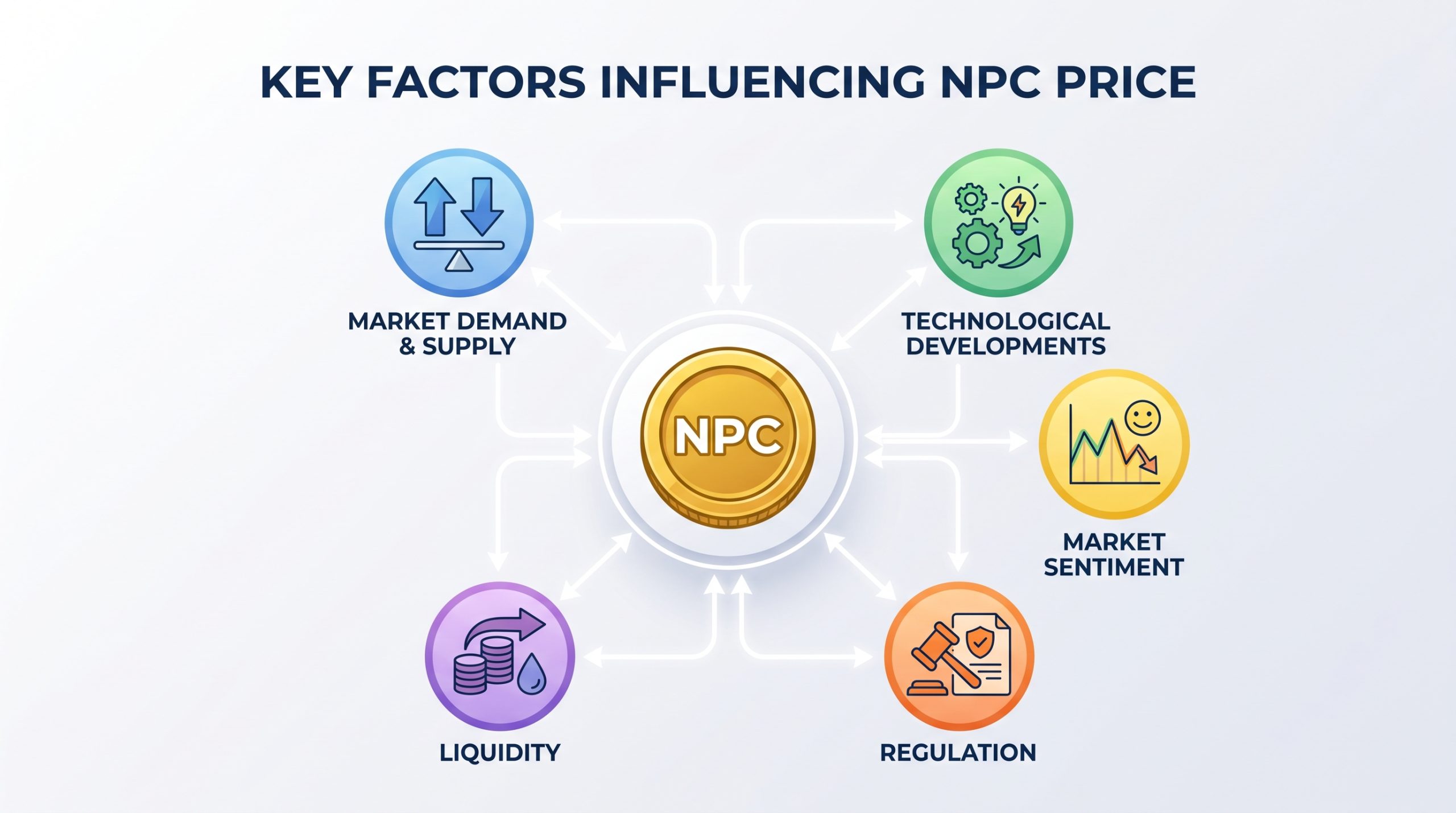

Navigating the volatile cryptocurrency market can be challenging, especially when it comes to predicting the price movements of emerging tokens like Non-Playable Coin (NPC). Understanding the factors that influence NPC’s value — market trends, technological developments, and community activity — is crucial for making informed decisions. This guide covers where NPC stands in 2026, what forecasters currently project, the analytical methods used to predict its price, and the risks that make any forecast uncertain.
Key Takeaways
- Comprehensive understanding of NPC: Grasp the unique features and strategic market position of Non-Playable Coin within the broader cryptocurrency ecosystem.
- Key price influencers: Market demand and supply, technological advancements, and community support all shape NPC’s price movements.
- Effective analytical methods: Combine technical and fundamental analysis to evaluate NPC’s future price trends.
- Prediction challenges: Market volatility, regulatory uncertainty, and data reliability all limit how accurate any NPC forecast can be.
- Forecasts are scenarios, not promises: Published price targets are model outputs built on assumptions and can change quickly as conditions shift.
NPC Price Snapshot and 2026 Forecasts
As of September 2026, CoinGecko lists the price of Non-Playable Coin at $0.02109, with a 24-hour trading volume of $4,988,983 — a 8.24% price increase over the past 24 hours. CoinMarketCap reports a live price of $0.02066 USD with a 24-hour trading volume of $4,804,270.18 USD.
Looking ahead, CoinCodex forecasts NPC to trade within a range of $0.01339 and $0.05455 in its 2026 outlook; if the token reaches the upper price target, that would represent a 174.14% increase. Kraken’s price prediction tool illustrates a simple scenario: assuming NPC changes at a rate of 5% every year, its price would be $0.020 in 2027 and $0.025 in 2031. Treat all of these figures as model outputs and calculator scenarios rather than guarantees — cryptocurrency prices are volatile, and forecasts can be overtaken by events.
Understanding Non-Playable Coins (NPC)
Non-Playable Coin represents a unique category within the cryptocurrency landscape: a digital asset not designed for direct use in gaming environments, but serving distinct purposes in the broader crypto ecosystem. NPC leverages blockchain technology to facilitate secure transactions, decentralized applications, and smart contracts.
- Decentralization: NPC operates on a decentralized network, eliminating intermediaries and reducing transaction costs.
- Smart contracts: Automated agreements enhance trust and reduce the potential for disputes.
- Scalability: NPC’s infrastructure supports high transaction volumes for both small- and large-scale applications.
- Security: Advanced cryptographic techniques protect transactions against fraud and unauthorized access.
- Interoperability: NPC integrates with other blockchain platforms, enabling diverse use cases and broader adoption.
NPC occupies a strategic position in the market by addressing needs such as enterprise solutions, decentralized finance (DeFi), and supply chain management. A strong, active community supports its development, and community-driven projects and partnerships bolster its credibility and market presence.
Factors Influencing NPC Price Predictions
Market Demand and Supply
NPC’s price is significantly influenced by demand and supply dynamics. When demand increases on positive investor sentiment or successful project developments, the price tends to rise; when supply outpaces demand, prices may decline. Monitoring trading volumes and circulating supply helps you assess these trends and anticipate potential price movements.
Technological Developments
Advancements in NPC’s underlying technology play a pivotal role in its price outlook. Enhancements in scalability, security, and interoperability can boost investor confidence and attract more users. Innovative features — improved consensus mechanisms or expanded smart contract capabilities — can differentiate NPC from competitors and positively affect its market value. Staying updated with the latest market news and technological milestones keeps you informed about factors that could influence NPC’s price trajectory.
Analytical Methods for NPC Price Prediction
Technical Analysis
Technical analysis evaluates NPC’s historical price movements and trading volumes. By examining chart patterns, trend lines, and indicators such as Moving Averages (MA) and the Relative Strength Index (RSI), you can identify potential price trends: a bullish MA crossover may signal upward movement, while an elevated RSI suggests overbought conditions. Analyzing support and resistance levels helps anticipate reversals, and tools like Fibonacci retracement and Bollinger Bands highlight key price zones and volatility ranges.
Fundamental Analysis
Fundamental analysis assesses NPC’s intrinsic value by examining technology advancements, market demand, and community support. Evaluating scalability, security features, and interoperability offers insight into long-term viability, while tracking adoption rates, strategic partnerships, and regulatory developments reveals how demand is evolving. Strong community support — active development and user engagement — positively influences market perception. Integrating these factors with technical signals gives you a fuller basis for judging NPC’s likely direction.
Challenges in NPC Price Prediction
- Market volatility: Rapid, unpredictable price swings can distort trends and patterns.
- Regulatory uncertainty: Unclear or evolving legal frameworks make it difficult to anticipate how compliance requirements will influence market behavior.
- Technological change: Breakthroughs or setbacks in scalability, security, and interoperability can alter investor confidence.
- Market sentiment: Sentiment shifts with news, social media trends, and broader economic indicators, and it is hard to quantify.
- Liquidity constraints: Low trading volumes can amplify volatility and expose the market to manipulation.
- Data reliability: Inconsistent or incomplete data weakens analytical models and reduces forecast reliability.
- External economic factors: Inflation, interest rate policy, and global economic health influence prices from outside the crypto market.
- Community and developer activity: Fluctuations in engagement or delays in project milestones introduce added unpredictability.
Future Outlook for NPC Prices
NPC’s trajectory hinges on several key factors. Continued technological innovation — particularly improved consensus mechanisms and transaction efficiency — could attract more projects and partnerships, driving demand higher. Growing interest in decentralized finance and enterprise solutions, areas where NPC holds strategic advantages, may support upward momentum if NPC captures a larger share of those sectors. Regulatory developments also matter: clear and favorable rules can boost investor sentiment and encourage institutional participation, while stringent policies could pose challenges. Expanding community support and active development remain essential for sustained growth and price resilience.
Conclusion
Navigating NPC price predictions requires a blend of analytical strategies and ongoing awareness of market dynamics. Balancing technical and fundamental analysis, tracking current market data from established trackers, and treating published forecasts as scenarios rather than certainties will help you capitalize on opportunities while managing risk. Staying adaptable in a volatile market keeps you ahead of trends.
Frequently Asked Questions
What is Non-Playable Coin (NPC)?
Non-Playable Coin is a cryptocurrency known for its decentralization, smart contracts, scalability, security, and interoperability. It serves needs in areas like enterprise solutions, decentralized finance, and supply chain management, and a strong community supports its development and adoption.
What is the current price of Non-Playable Coin?
As of September 2026, CoinGecko lists NPC at $0.02109 with a 24-hour trading volume of $4,988,983, while CoinMarketCap shows $0.02066 USD. Prices move constantly, so check a live tracker before acting.
How can investors predict NPC’s price?
Combine technical analysis — historical price movements, trading volumes, and indicators like MA and RSI — with fundamental analysis of NPC’s technology, market demand, and community support. Together these methods provide a more complete view of likely price movements.
What are the challenges in predicting NPC’s price?
Market volatility, regulatory uncertainty, rapid technological change, shifting sentiment, liquidity constraints, and data reliability all complicate forecasts. External economic conditions and the strength of NPC’s community and development team also affect its price.
Why is continuous monitoring important for NPC investors?
The cryptocurrency market is highly dynamic. Regularly tracking trading volumes, community developments, technological milestones, and regulatory changes allows you to respond quickly to price fluctuations, adjust your strategy, and manage risk effectively.